
Market Overview
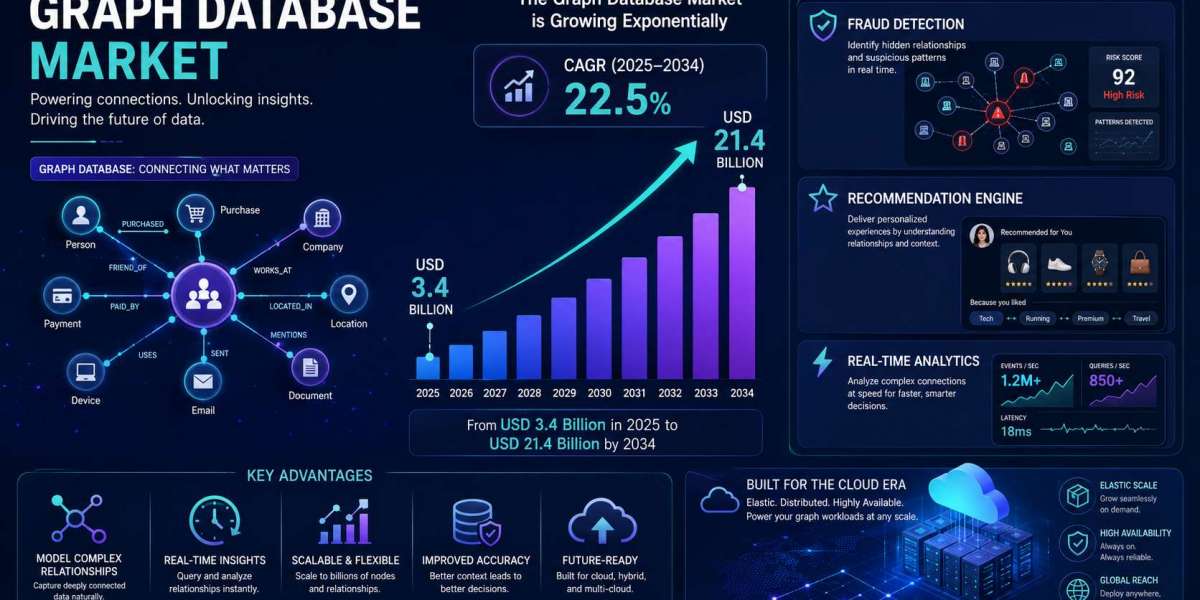
According to Dimension Market Research, the Global Graph Database Market is projected to reach USD 3.4 billion in 2025 and expand to USD 21.4 billion by 2034, growing at a robust CAGR of 22.5%. This growth is driven by rising demand for connected data analytics, real-time relationship mapping, and scalable NoSQL solutions across industries.
A graph database is a type of NoSQL database that uses graph structures with nodes, edges, and properties to represent and store data. Unlike traditional relational databases that rely on tables, rows, and columns, graph databases are optimized to handle complex and highly connected data. This structure enables efficient querying of relationships, making them ideal for applications such as fraud detection, recommendation engines, knowledge graphs, and social network analysis.
The global graph database market is experiencing rapid expansion as organizations demand advanced data modeling techniques that surpass relational constraints. The surge in connected data across industries such as BFSI, telecom, retail, and healthcare is propelling the adoption of graph technology for real-time analytics, identity resolution, and enterprise knowledge management. Businesses are seeking solutions that offer flexible schema design, scalability, and the ability to uncover hidden patterns in complex data sets.
With the rise of digital transformation, enterprises are integrating graph-powered systems to enhance customer experience, streamline operations, and drive intelligent automation. The market growth is further supported by growing investment in cloud-based graph solutions and open-source technologies, enabling enterprises to analyze large-scale, interconnected datasets in real time.
Definition and Market Significance
A graph database is a specialized NoSQL database designed to store, manage, and query highly connected data using graph structures consisting of nodes (entities), edges (relationships), and properties (attributes). Unlike relational databases that use tables and joins, graph databases use a flexible, schema-free model optimized for traversing relationships at scale.
The importance of graph databases lies in their ability to efficiently handle complex, multi-hop relationships that are difficult and slow to query with traditional relational databases. They excel at applications requiring real-time relationship analysis, such as fraud detection, recommendation engines, social network analysis, knowledge graphs, and supply chain optimization.
Graph databases also support broader digital transformation initiatives by enabling organizations to build intelligent applications powered by connected data, enhance AI and machine learning models with relationship-driven insights, and drive data-driven decision-making across complex enterprise ecosystems.
Market Drivers
A major factor driving the Graph Database Market is the rising demand for real-time relationship mapping. With enterprises focused on understanding complex interconnections between users, transactions, and systems, graph databases excel in modeling dynamic and highly connected datasets, enabling organizations to visualize and analyze data relationships instantly.
The growth of big data and AI integration is another key driver supporting market expansion. The proliferation of big data across enterprises has created a need for databases that can handle intricate data relationships at scale. Graph databases support artificial intelligence and machine learning applications by offering fast traversal of connected data and efficient data modeling.
The increasing complexity of data and the need for advanced analytics are also contributing to market growth. Organizations across BFSI, telecom, retail, and healthcare are adopting graph technology for real-time analytics, identity resolution, and enterprise knowledge management.
Market Trends
The emergence of Graph AI and Graph Neural Networks (GNNs) is transforming the market. GNNs are enabling more accurate and scalable analysis of graph-structured data, powering applications in recommendation engines, fraud detection, and drug discovery, driving a new wave of innovation in advanced analytics and cognitive computing.
Another significant trend is the growth of cloud-native and managed graph database services. With the growing shift to cloud computing, graph database providers are offering fully managed services that support scalable and cost-effective deployment, allowing businesses to avoid infrastructure overhead while benefiting from high availability and real-time performance.
The expanding use of graph databases in cybersecurity and threat intelligence is also reshaping the market. Security analysts are using graph analytics to trace lateral movements in network intrusions, identify anomalies, and uncover hidden vulnerabilities.
Market Restraints
Despite its strong growth potential, the graph database market faces certain limitations. The lack of standardized query languages and tooling creates a fragmented ecosystem, with Cypher, Gremlin, and SPARQL being commonly used but no universally accepted standard, challenging developers and data engineers in learning, integration, and interoperability.
High complexity in implementation and migration is another significant restraint. Deploying graph database solutions often requires a complete restructuring of existing data architectures, involving significant time, cost, and technical expertise, particularly for organizations used to relational database management systems.
In addition, the steep learning curve and the need for specialized talent limit the market's accessibility, particularly for small and medium-sized enterprises that may lack the resources to manage complex graph data infrastructures.
Market Opportunities
Expanding use in cybersecurity and threat intelligence presents a significant opportunity. As cyber threats become more sophisticated, graph databases offer a strategic advantage in identifying anomalies and attack patterns by mapping relationships across users, devices, and access points.
Adoption in healthcare data interoperability is another promising opportunity. Graph databases are being used to link patient records, medical research, clinical trials, and drug data, improving diagnostic accuracy, streamlining clinical workflows, and accelerating drug discovery.
Furthermore, the growth of digital transformation initiatives across emerging economies is expected to open new opportunities for the graph database industry, as organizations seek advanced data management solutions to handle complex relationships and drive intelligent automation.
Segmentation
The Graph Database Market is categorized based on component, deployment mode, database type, organization size, application, and industry vertical.
By component, software components are anticipated to dominate with approximately 75.0% of the total market share in 2025, driven by widespread deployment of graph database platforms that support high-performance querying, data visualization, and real-time analytics.
By deployment mode, cloud-based solutions are expected to lead with around 66.0% of the market share in 2025, driven by scalability, flexibility, and cost-efficiency, enabling faster implementation and managed services.
By database type, property graphs are set to dominate with 70.0% of the market share in 2025, attributed to their intuitive structure, flexibility, and strong support for practical use cases across various industries.
By organization size, large enterprises are projected to retain a dominant position with 72.0% of the market share in 2025, stemming from their vast and complex data ecosystems requiring advanced tools to model and analyze relationships.
By application, fraud detection and prevention is expected to capture the largest share with 23.0% of the market value in 2025, driven by the growing need among financial institutions and e-commerce platforms to identify and mitigate fraudulent activities in real time.
By industry vertical, the BFSI sector is expected to dominate with 26.0% of the market share in 2025, adopting graph database technologies to strengthen fraud detection systems, comply with regulatory requirements, and build customer-centric strategies.
Regional Analysis
North America is projected to lead the global graph database market in 2025, capturing 38.0% of the total market revenue. This dominance is driven by the region's early adoption of advanced data technologies, strong presence of key market players, and a highly developed IT infrastructure. The United States is a key driver, with the US market projected to be valued at USD 1.1 billion in 2025 and expected to reach USD 6.1 billion by 2034 at a CAGR of 21.1%. Enterprises across finance, healthcare, retail, and technology are leveraging graph databases for fraud detection, recommendation engines, knowledge graphs, and network analysis.
Europe is projected to reach approximately USD 800 million in 2025, attributed to the region's advanced IT infrastructure, growing emphasis on data privacy and compliance, and widespread adoption of digital technologies. The European market is expected to grow at a CAGR of 21.2% from 2025 to 2034, driven by rising demand for AI-powered analytics and enterprise knowledge graphs.
Asia Pacific is expected to witness significant growth in the graph database market over the coming years, driven by rapid digital transformation, growing investments in cloud infrastructure, and rising adoption of advanced analytics across emerging economies such as China, India, and Southeast Asia.
Japan is estimated to be valued at around USD 130 million in 2025, representing approximately 3% of the global market, with a projected CAGR of 20.1% from 2025 to 2034, fueled by rising demand for real-time analytics and AI-driven applications.
Request a Complimentary PDF Sample
https://dimensionmarketresearch.com/request-sample/graph-database-market/
Competitive Landscape
The global competitive landscape of the graph database market is characterized by intense innovation and strategic expansion, with both established technology giants and emerging startups vying for market share. Leading players such as Neo4j, Amazon Web Services, Microsoft, IBM, and Oracle are continuously enhancing their graph capabilities through feature-rich platforms, AI integration, and cloud-native offerings.
Niche vendors like TigerGraph, ArangoDB, and Dgraph Labs are gaining traction by offering specialized, high-performance graph solutions tailored for advanced analytics and real-time querying. Recent developments include Neo4j's release of Neo4j Aura Graph Analytics (May 2025), IBM's acquisition of DataStax (May 2025), and Ontotext merging with Semantic Web Company to form Graphwise (October 2024).
Technological Advancements
Rapid advancements in graph database technology, including Graph Neural Networks (GNNs) and AI integration, are transforming the market. GNNs enable more accurate analysis of graph-structured data, powering advanced applications in recommendation engines and fraud detection.
Cloud-native graph database services are also playing a significant role, offering scalable, cost-effective deployment with high availability and real-time performance. Integration with big data platforms and AI frameworks further expands the capabilities and accessibility of graph databases.
Consumer Adoption Patterns
Enterprises across BFSI, IT and telecom, retail and e-commerce, healthcare, manufacturing, government, and media are increasingly adopting graph databases for their ability to handle complex relationships and provide real-time insights. The growing availability of managed cloud services and open-source options is making graph technology more accessible to organizations of all sizes.
Regulatory Environment
Regulatory frameworks such as GDPR in Europe and data localization policies in various regions influence the adoption and deployment of graph databases. Compliance with data privacy regulations drives enterprises to adopt sophisticated data management systems, with graph databases emerging as a preferred solution for handling complex and interconnected data.
Market Challenges
The graph database market faces challenges related to the lack of standardized query languages, high implementation complexity, migration difficulties from relational systems, and the need for specialized talent. Additionally, competition from traditional relational databases and other NoSQL solutions can limit adoption in certain use cases.
Future Outlook
The future of the Graph Database Market remains highly promising as organizations increasingly recognize the value of connected data analytics and relationship mapping. Integration with AI and machine learning, expansion of cloud-native services, and growing use cases in cybersecurity, healthcare, and supply chain optimization are expected to drive strong market growth during the forecast period.
FAQs
What is the expected size of the Graph Database Market in 2025?
The market is expected to reach USD 3.4 billion in 2025.
What is the projected market value by 2034?
The market is forecast to reach USD 21.4 billion by 2034.
What is the CAGR of the Graph Database Market?
The market is expected to grow at a CAGR of 22.5% during 2025–2034.
Which component dominates the market?
Software components are anticipated to dominate with approximately 75.0% share in 2025.
Which region leads the global graph database market?
North America is projected to lead with 38.0% of total market revenue in 2025.
Summary of Key Insights
The global Graph Database Market is expected to grow from USD 3.4 billion in 2025 to USD 21.4 billion by 2034, recording a CAGR of 22.5% during the forecast period. Software components lead with 75.0% share, while cloud-based deployment dominates with 66.0% share. Property graphs lead database types with 70.0% share, and large enterprises represent 72.0% of organization size share. Fraud detection and prevention leads applications with 23.0% share, and BFSI dominates industry verticals with 26.0% share. North America holds the largest regional share with 38.0% of global revenue in 2025. The US market is projected to reach USD 6.1 billion by 2034 at a CAGR of 21.1%.
Purchase the Full Report
https://dimensionmarketresearch.com/checkout/graph-database-market/